A new open standard for AI-assisted software development
Structured Context is a machine-readable way to align human intent, AI systems, and autonomic governance.
What Is Structured Context?
Structured Context is a compact, standardized way to describe the essential elements of a project—so both AI agents and humans can clearly understand what is being built, why, and under what constraints. It captures only the most critical architectural, functional, security, compliance, and operational requirements needed to guide AI-assisted work.
Each Structured Context bundle is intentionally designed to fit comfortably inside an LLM's context window (usually 25–35% of available tokens). This leaves room for live conversation, task-specific prompts, and agent memory, while ensuring every agent always has the same, authoritative understanding of the project. Larger or historical information stays in RAG—not in the prompt.
The result is a practical, portable, version-controlled project brain that any agent (or developer) can load instantly. It keeps intent, requirements, and constraints aligned across the entire lifecycle—from design, to build, to governance—without ever overwhelming the model.
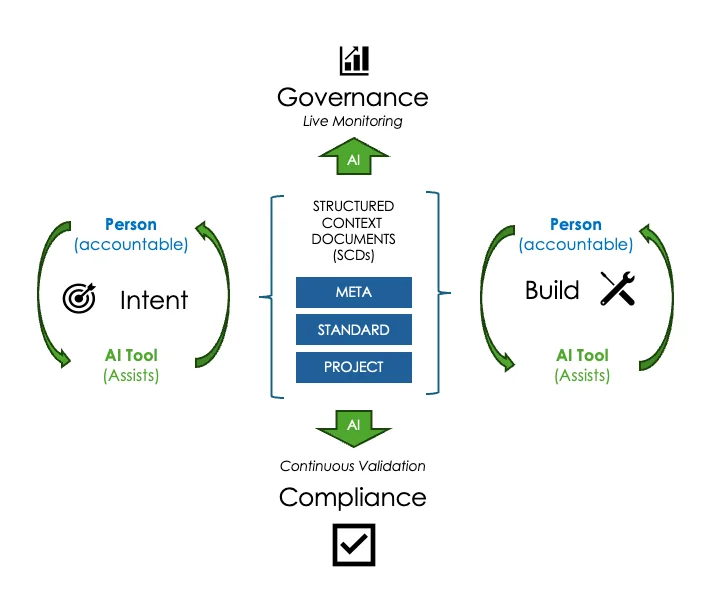
The Structured Context Specification (SCS)
Structured Context Specification (SCS) is an emerging open standard for AI-native software development. It defines a compact, machine-readable format for expressing the essential elements of a system—its purpose, constraints, architecture, risks, and requirements—so that both humans and AI agents share the same authoritative source of truth.
SCS organizes structured context into three tiers:
- Meta Context — Rules for how SCDs (Structured Context Documents) must be authored, validated, and governed.
- Standard Context — Domain-specific requirements derived from regulatory frameworks, industry standards, or organizational policy.
- Project Context — The system-specific intent, architecture, constraints, and operational expectations of a particular solution.
Together, these tiers form a portable, version-controlled "project brain" that any tool or agent can load instantly. SCS ensures clarity, interoperability, and safe automation across the entire development lifecycle.
Why Structured Context Is Needed
Modern software development—especially with AI tools—suffers from four systemic problems:
1. AI hallucination caused by missing or inconsistent context
LLMs generate incorrect or risky output when they lack clear intent, detailed constraints, or authoritative project boundaries.
2. Requirements scattered across documents, slides, tools, and teams
Most organizations store critical knowledge in formats that humans can read, but AI systems cannot reliably consume.
3. Governance and compliance cannot keep pace with rapid development
Security, privacy, and regulatory requirements are usually checked manually, long after code is written.
4. Teams spend enormous time restating the same information
Every engineer, architect, and AI agent ends up rebuilding a mental model of the system from scratch.
Structured Context addresses these problems by providing a single, machine-readable, always-current representation of intent, requirements, architecture, and constraints. It ensures every contributor—human or AI—works from the same shared understanding.
What We Aim to Accomplish
The goal of SCS is to make AI-assisted development safer, faster, and more predictable. The specification enables:
Autonomic Governance
AI continuously monitors architecture, security posture, dependencies, and changes against the authoritative SCD bundle.
Continuous Compliance
Security, privacy, regulatory, and organizational controls are validated automatically during design and throughout the build process.
Higher-Quality Code
AI tools generate far better results when guided by precise, concise context describing system boundaries, constraints, and intent.
Reduced Risk
By constraining the "solution space," SCDs prevent AI from producing incomplete, non-compliant, or unsafe designs.
Interoperability Across Tools and Agents
Every AI agent can load the same Structured Context bundle, ensuring consistency across analysis, design, testing, and governance tools.
Predictable, Auditable Outcomes
All decisions trace back to a single source of truth, versioned in Git, reviewable by humans, and enforceable by AI.
Project Status & Roadmap
The Structured Context Specification is currently in active development. The following milestones are underway:
- Specification Draft — Finalizing minimum SCD categories and rules for validation across Meta, Standard, and Project tiers.
- Reference Implementation — A working example system demonstrating how SCDs guide AI-assisted development, testing, governance, and compliance.
- Validator Tool (v0.1) — First release planned for launch. Ensures SCD bundles adhere to the specification and are safely consumable by AI agents.
A public GitHub repository will be available at launch, along with contributor guidelines and documentation.
How to Participate
Structured Context is an open standard, and community involvement is essential.
You can participate in several ways:
- Follow the project and watch for updates on GitHub (public at launch).
- Join the structured context discussions on GitHub Discussions and Reddit (coming soon).
- Review the specification draft once published and contribute feedback, proposals, or extensions.
- Test the validator and reference implementation when early releases become available.
- Help shape best practices for safe, auditable, AI-native development.
The project aims for a community-driven, transparent, and standards-oriented process aligned with modern AI governance needs.
Structured Context Community
SCS Spec
Core specification and validator
SCS CLI
Command-line interface for Structured Context
SCS Registry
Community registry
Coming SoonReference Implementation
Healthcare medication adherence example demonstrating SCS